« January 2006 | Main | March 2006 »
February 28, 2006
How to buy a telescope
After looking at the high resolution versions of the 200 megapixel view of the Pinwheel Galaxy taken by the Hubble Space Telescope

and seeing the effects of light pollution on urban skies - as an example compare these two images taken during and after the 2003 Eastern North America Blackout:


I have concluded that for looking at the stars the best view can be obtained not with any telescope which you can buy in a store, but simply by buying a computer and getting a fast internet connection.
Trying to see the details of constellations and other cosmic wonders through a backyard telescope is rather like producing an international news broadcast by walking around with your video camera. Doing so might be fun, but the results are not comparable to what you can find simply by googling for a few minutes.
Thanks to the "Bad Astronomer", Phil Plait for pointing me to the image of the Pinwheel Galaxy.
Posted by Jack at 10:25 AM | Comments (1) | TrackBack
February 24, 2006
Software is Different or New is the New New
Ah, it continues. A long standing discussion equivalent to the following code:
Do While x<>y

x =  1

y = 0

Wend
Glen and David are both smart guys. Why can't they just get along?
I think it comes down to a sort of pride. David is quite proud of what he has done in promoting an "Agile Software Development" point of view. It is a pride both based on effectiveness and on novelty, that is it is the "creation" of something new. As such, there is a reluctance to acknowlege that it is similar or based on any past model. This is not unusual. Indeed it is quite common. "New" is the new "new". Humans are drawn to the new thing and there is excitement about adopting it. This is the ideal situation for selling something whether it is ideas, books or software development tools.
On the other hand Glen is proud too. He has pride in doing his job well and being part of a tradition of people who have done so. When someone slights that tradition (one which is actually rich with the adoption of the new) then it requires correction, and thus is born controversy.
I'd be remiss if I didn't take sides on this. After many years of architectural education it becomes obvious that "New" just doesn't matter all that much in the long haul. A lot of what is new is reworking of the old. And what matters is how effective you are at creating something that is needed or desired.

Just as an ancient statue of Medusa becomes just another block in the drinking water system for Istanbul, the ideas of the past are just building material for the ideas of the future. Failure to look at them and understand how they can be useful is wasteful. Failure to acknowlege that you have build upon the head of the Medusa is vain.
Note: When Justinian constructed the Basilica Cistern in 532 AD, bits of more ancient monuments were put to use. The current use is as a tourist attraction. Visiting the cistern is a cool and refreshing activity on a warm Turkish afternoon
Posted by Jack at 01:40 PM | Comments (0) | TrackBack
Using Wikipedia to Promote Office 2007 and Project 2007
I guess it should be there, but it just seems odd that such a thing is in an online "encyclopedia"
Microsoft Office 2007 - Wikipedia, the free encyclopedia
Posted by Jack at 10:49 AM | Comments (0) | TrackBack
February 23, 2006
Changing Management Processes in Organizations - a Lesson from Public Health
A recent article in the Scientist:
The Scientist : Battling Bad Behavior outlines some of the obstacles to behavioral change - primarily related to public health, and lists a number of the ways to encourage adoption. Looking at the positive side here are the techniques presented for removing the obstacles:
- Make It Easy
- Don't Underestimate Peer Pressure
- Provide Immediate Feedback
- Be Understood
- Confront Misinformation
- Link to Existing Beliefs
- Effective Presentation
Much of the above might seem obvious, but if you are trying to make changes or implement something new it would be worthwhile to look at how well you are doing all of the above.
Posted by Jack at 01:55 PM | Comments (0) | TrackBack
Where are you sitting today?
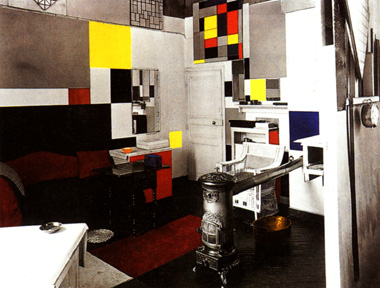
Mondrian added a little color to his studio to break things up a bit. In light of this recent research by Elizabeth Gould summarized by Kathy Sierra here:
Creating Passionate Users: Brain death by dull cubicle
it looks like a good idea. It also make me wonder what size a computer screen needs to be before it is considered "the environment". For years I've been thinking that a "desktop" should be about the size of a desktop. And then the question is whether a flat screen can ever replace the variety and challenge that a real three dimensional environment presents to the eye, mind and the body?


Source: http://www.2loop.com/3drooms.html
I suppose the lesson for us all is to change things around when things start getting stale. Or better yet, take a break from your enviroment once in a while by taking a walk.
Posted by Jack at 10:37 AM | Comments (0) | TrackBack
All your page are belong to us
Google is now hosting free webpages - well, they have provided some and are now oversubscribed, but if you want to see what it look likes here is an example from the ever enthusiastic Josh Bancroft:
jabancroft - Josh Bancroft's Google Page
I'm not sure why Josh claims it is cool, new and fancy or web 2.0, but I suppose it would be boring if it wasn't all of those things even if it really doesn't seem to be any of them to me.
It looks like a good way to get kids on the web though. Free is always a good strategy for getting people to try something new.
Posted by Jack at 09:59 AM | Comments (1) | TrackBack
February 22, 2006
Google and the Law and ... um ...privacy
I see that Google has posted their official response to the request for a "million URL's" by the department of Justice. You can read it here. They argue three main points, that the data as requested is useless, that it may expose google trade secrets and that it would be too much work for Google to supply a million "random" URL's. Privacy concerns and "chilling effect" are thrown in for good measure, but it appears to me that these are more in support of Google's business model which is based on the perception of user privacy. While I remain unconvinced that there is not some bit of evil lurking in the heart of Google, this is generally a good thing.
I'm most interested in writing about it from an analytical point of view. It is nice to see a case where "data" is held out as NOT being the answer to a question. This is not to say that data is useless - no one would argue that, but it is a clear statement that a particular set of data may not be suited to a particular purpose. In this case, crafting a law based on search results just seems to be a bad idea. Here is what they say about it:
"First, the Government's presentation falls woefully short of demonstrating that the requested information will lead to admissible evidence. This burden is unquestionably the Government's. Rather than meet it, the Government concedes that Google's search queries and URLs are not evidence to be used at trial at all. Instead, the Government says, the data will be "useful" to its purported expert in developing some theory to support the Government's notion that a law banning materials that are harmful to minors on the Internet will be more effective than a technology filter in eliminating it.
Google is, of course, concerned about the availability of materials harmful to minors on the Internet, but that shared concern does not render the Government's request acceptable or relevant. In truth, the data demanded tells the Government absolutely nothing about either filters or the effectiveness of laws. Nor will the data tell the Government whether a given search would return any particular URL. Nor will the URL returned, by its name alone, tell the Government whether that URL was a site that contained material harmful to minors."
Earlier you may have caught that I feel the privacy thing is gratuitous and perhaps a bit ingenuous and to see why I believe this, here is a sample entry from my logs today:
xx.xxx.137.74 - - [22/Feb/2006:10:25:50 -0500] "GET /blog/archives/pmi-and-pmp/pmp-exam-cheats.html HTTP/1.1" 200 13096 zo-d.com "http://www.google.co.uk/search?hl=en&q=PMP+cheat+test+answers" "Mozilla/4.0 (compatible; MSIE 6.0; Windows NT 5.1; {0EF9B069-A48C-18A5-1EEF-88AC09646F5E}; .NET CLR 1.0.3705; .NET CLR 1.1.4322)"
I x'ed out the IP address, but this is typical of what shows up in my logs when someone arrives here from a Google search. The first part is the IP address, then date, the page they are directed to here, some data about http response and size, and then the search itself. This is followed by browser identification. A simple lookup of the IP address shows that it comes from inside one of the big computer manufacturing companies. The fact that google passes along the search terms when it refers a user to my site is great for me. I use it to understand what people are looking for when they arrive here and occasionally write things which respond to those sorts of requests, but since the IP address of the user is passed along too, it is not particularly private.
Most people ending up here are looking for things they don't need to keep to themselves, but if my content were a bit more shady I can imagine that I'd be getting a lot of information from google about the dark side - information that includes where that person is on the internet. This sort of information is not what the government should be using to fish for new ways to make laws, but it is hardly the hallmark of privacy protection.
Posted by Jack at 10:34 AM | Comments (0) | TrackBack
February 21, 2006
Seth suffering from short attention span
Seth Godin seems to be forgetting the past. He claims that dissatisfaction is "a trend that is accelerating through every market and community on Earth." in his recent post:
Seth's Blog: The culture of dissatisfaction
Sorry Seth, I'm not believing that the good old days were any better than now in this regard. The culture for as long as I've been alive (and apparently even before then) has been dissatisfied. How about some signposts you ask?
- "I can't get no..." - The Rolling Stones
- "I'm mad as hell and I'm not going to take anymore" - Network
- "Who's afraid of Virginia Wolfe" - Edward Albee
- Little things like tearing down the Berlin Wall, throwing tea in miscellaneous harbors and the effective use of the guittotine in the French Revolution.
Given this sort of precedence and innumerable 1950's/1960's marketing critiques in vintage Mad Magazine I find it hard to believe that dissatisfaction is an "accelerating" trend. Or that Las Vegas is the most visible sign of it. Further, I'm not so certain that "marketing" is powerful enough to create such a culture. Certainly it can contribute, but dissatisfaction is not something you can create with billboards. And finally, Seth, if it is truly a "fact that we're unhappy all the time", take a break and take a few deep breaths. You have a lot to be thankful for.
Posted by Jack at 03:28 PM | Comments (0) | TrackBack
Free PMBOK Download - oops
I was wrong. Apparently there ARE still copies out there on the web for download. For example, here are a number of results which suggest that the 1996 and 2000 versions are still out there on many unsecure sites.
http://www.google.com/search?q=inurl:pmbok.pdfI suppose this should not be a surprise. But users should not be reduced to copyright violation or pirating just to hear what PMI clearly believes are the "right" project management methods. If PMI's PMBOK is the project management "bible", then where is their Gideon? Come on PMI, set the PMBOK free.
Posted by Jack at 12:22 PM | Comments (1) | TrackBack
February 17, 2006
Not Project 12, Not Project 2006, Announcing Microsoft Office Project 2007
Looks like the newest versions are coming late enough in 2006 that it made sense to name them after next year.
Also the version names seem to be growing every year, first they added Project Standard and Project Professional, now they are Microsoft Office Project Standard 2007 and Microsoft Office Project Professional 2007 along with Microsoft Office Project Server 2007 and Microsoft Office Project Portfolio Server 2007. Quite a mouthful.
Pricing data is here and you can sign up to be notified of the latest news and beta2 releases here
Despite the long names it is good to see that Project is becoming more widely considered part of the office family.
Posted by Jack at 01:14 AM | Comments (1) | TrackBack
February 15, 2006
Search Result of the Day
My referrer log shows how people find this site. A large number are through searches. Some are unpublishable and others are just odd. This one showed up and is so easy to answer that I decided to answer it twice - with conflicting answers:
does buying more lottery tickets increase your chance of winning? - Yahoo! Search Results
The simple answer is yes. If they sell as many tickets as there are buyers then with each ticket you buy you increase your chance and decrease the other person's chance. If there are two buyers and you each buy one ticket you have a 50% chance of winning. If you then buy one more, you have a 66% chance of winning. The equation behind this holds for any positive number.
But the complex answer is that in a lottery money is siphoned off to pay for the companies which think up, advertise and run the lotteries, not to mention the states taking a portion for schools so statistically a lottery is a losing bet. In the big picture buying more tickets merely means you lose more.
Posted by Jack at 05:19 PM | Comments (0) | TrackBack
February 14, 2006
Digital imaging and the end of megapixels
An interesting article from Nikon about how digital imaging has evolved and where it is heading.
Nikon Imaging | Behind the scene : Nikon Digital Image Processing Technologies and the D200Besides the fact that it appears that the trend will not be to more megapixels, but rather in improving image quality, I was interested to see that color rendition is something which is both culture and location specific.
Posted by Jack at 11:11 AM | Comments (0) | TrackBack
February 13, 2006
How to build your own motorcycle?
I get quite a few people coming here as a result of searching for the phrase "build your own motorcycle". I think this is because of my posts on the ugliest motorcycle (also on Ratbikes here). So I decided to take a look at what comes up in a search and found that most of the sites have nothing to do with actually building motorcycles. One was a site which showed a computer built in the shape of a motorcycle. Others described options available for custom cycles (in my opinion choosing wheels and colors from a catalog is hardly building your own motorcycle) and nothing really covered the design of the motorcycle, but at least this page from Miller Welding covers the welding techniques used to put together the frame.
If you always wanted to know the practical difference between GMAW and GTAW that site is the place for you.
Posted by Jack at 12:15 PM | Comments (1) | TrackBack
February 10, 2006
Alcatraz - D block
D Block was the maximum security wing at Alcatraz. This is were prisoners were sent to isolate them from the rest of the prison. Here is how it looks these days:
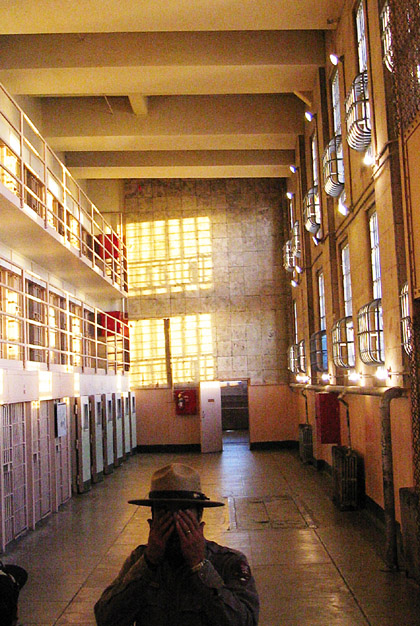
The green doors at the end of the ground floor are the isolation cells which are sound and light insulated and have a cold steel floor for the prisoners to sleep on.
In this photo though, with the warm Western light streaming in, D block seemed to be one of the more pleasant areas of the prison, especially on the upper levels with a view of the Golden Gate. I suppose the question is whether the view would sustain you or merely taunt you about what you are missing.
Posted by Jack at 11:37 AM | Comments (0) | TrackBack
Accoona or the lifespan of a robot
I've written before about the incredulous claims made by the Accoona search engine and the past day or so they showed up in my logs. Looks like they are near death:
I suppose I shouldn't be surprised to see that sloppy (I hesitate to say deliberately misleading) analysis ended up in such an unfortunate trajectory, but it is a nice little lesson. One should be more responsible to one's workers.
Posted by Jack at 09:57 AM | Comments (0) | TrackBack
February 09, 2006
News from the Microsoft Project 12 team
DieterZ is moving on to a new position and is leaving the communication about the next version of Project and Project Server to Lidiane Souza. You can find her here: http://blogs.msdn.com/project/default.aspx
The only issue is that her latest post which states "Hopefully we’ll be able to build a good community on this blog.. Sadly, comments are not allowed and there is no email address for her... Hopefully she will get this straightened out.
Posted by Jack at 04:28 PM | Comments (0) | TrackBack
Tools are not the answer
As much as I decry the tendency for people to latch onto tools as solutions to their problems, I still can't draw myself completely away from them.
They are clearly a part of the solution, and they are frequently interesting in their own right. My new and sparsely populated "Stuff" blog covers things which are interesting in the way they work / or don't work.
Suggestions for reviews are always welcome.
Pop on over and take a look!
Posted by Jack at 02:58 PM | Comments (0) | TrackBack
February 08, 2006
For the birds
Alcatraz's current population is dominated by seagulls like this:

Walking around the island in the early morning is almost like being in Hitchcock's "The Birds" with birds sitting on rubble and railings and rooftops quietly staring at whatever passes by.
Posted by Jack at 09:08 PM | Comments (0) | TrackBack
February 07, 2006
Microsoft Project 12 / Project 2006 / Project ? Feature List
Microsoft is busy working on the next version of Project and Project Server. So far they have disclosed a few new features and improvements. This entry is a running list of what they have disclosed so far (limited of course by my available energy to gather and summarize). I'll try to keep it updated. If you have any other public disclosures of features let me know and I'll add them: Now the list in no particular order:
Desktop Features:
Project Pro - Project Server:
To Be Continued...
Posted by Jack at 10:58 AM | Comments (1) | TrackBack
Pinky blue, green and orange

Web 2.0 is all that and MORE!
Still I'm perplexedly underwhelmed...
Source: Stabilo Boss via Gen Kanai
Posted by Jack at 10:42 AM | Comments (0) | TrackBack
Persistance of Vision
I was a judge at my son's science fair this last weekend. Besides being treated to a description of how an 8 year old could tell that rats prefer peanut butter to cheese because the rat caught in the peanut butter trap had bled more - implying it had got there first, there are some interesting results. Sometimes they are things which you already know, but are happy to get confirmation of (the laws of physics still apply), sometimes they are things you weren't sure of but are nice to know in case you are caught in a tough situation (a longer sling on a catapult will fling a baseball further) sometimes they remind you that constructing the experiment to get valid results is the difficult part (though seeing sparks fly is always good fun) sometimes you see that the data is ignored in favor of the desired results (one kid threw out the unexpectedly high tensile strength found in a sample of fishing line as he thought it was too high) and sometimes they make you think about what you take for granted.
This last one was demonstrated by an experiment where one of the kids put a sign in the street telling people to go slow and measured the speeds of the cars with and without this sign. To get good data they did it three days and found that on their residential street it reduced the speed of cars by an average of 4 mph. This brought the speed of the cars from somewhere just over the speed limit to just under the speed limit.
But looking closer disclosed something else. If you looked at the data for the second and third days you would see that there was a much smaller (or even non-existant - I was just eyeballing this so it was hard to tell exactly) drop in speed due to the presence of the sign.
So rather than the claimed 4MPH drop, there was really a BIG drop on the first day and NO drop on subsequent days. Assuming that residential traffic consists of a small consistant group of travelers it pointed out to me that the sign was only effective the first time people saw it. After that it had become just part of the landscape and was ignored.
The lessons from here for scheduling or project management are clear. If you want something to stand out and take action, do it strongly and infrequently.Change the way you present your message so that it is novel and interesting.
If you look, you can sometimes find a corollary to a principle. In this case the evil corollary is that if you want to hide something, hide it in plain sight. Cry wolf every week and people will stop bothering you about why your project is in trouble. They just won't see it any more. Boredom is the friend of the failing project.
Posted by Jack at 09:54 AM | Comments (0) | TrackBack
Not fade away
Thomas Crampton, a guest poster on Joi Ito's Wep points to an interesting Wired article on how few podcasters are able to maintain their effort over an extended time:
Joi Ito's Web: Podcasting: The end of amateur hour?
Interestingly enough Thomas' presence as a guest blogger is a partial solution to the problem of keeping a periodic publication active in the face of declining interest by the founder who was once one of the most popular bloggers but whose "ranking" has been eclipsed by blogs which talk about gadgets and the oddities of the world.
Personally I don't see the emergence of the "mainstream media" in what Thomas calls the "new media space: as a threat to any one who is doing what they like to do. Unless what they like to do is be a big star...
Of course, what do I know? I am not a podcast listener.
Posted by Jack at 09:52 AM | Comments (0) | TrackBack
February 06, 2006
Audiobooks frustration
I hardly have enough time to read many things I've been wanting to read so I checked out a couple of audio books from the library. To put it briefly, they are excruciating. Sure, you may be stuck in your car and there isn't a whole lot else to do, but if the two I've suffered through are any example I have to say that they are not a pleasure.
There are a couple of reasons for this. The first is that listening is much slower than reading. The spoken word is more concise than the written word. Because writers are blessed with readers who can read faster than most people can talk, writers can create substantial and convoluted sentences. They can waste words. They can write so you need to read it twice. And of course, as with any blessing it is blasphemy to waste it so they do these things. In the case of the books I've heard so far it I'd estimate that listening to the book is longer than it would take me to read it by at least a factor of two. I read fairly quickly so it is not inconceivable that I could finish these books in 1/5th the time. Shifting to this slow speed is like swimming in molasses. Every stroke is laborious and you just hope it will end soon.
The second is that the writers are not writing their work for it to be read aloud. I think they should. It would make their work more lyrical. Of course writing with some sort of rhythm or lyricism is difficult and maybe out of place in technical topics, but that is no excuse. Nothing highlights an awkward sentence better than having some slow-reading grave-voiced actor mouth it in a near monotone. Nothing is more devoid of rhythm than an enunciated bullet list. Of course some fault may lie with the readers. So far none of them seem to own the words coming out of their mouths.
Two is too small a sample for me to give up so I'll continue listening, and waiting, and hoping that maybe the next one will be better.
Posted by Jack at 03:30 PM | Comments (1) | TrackBack
OMG that is like sooo cool
Dieter Z. points out some of the background behind multiple level undo which is now part of Project 2006 (keep the stories coming Dieter) and relates how a customer exclaimed "Oh My God..." when it was demo'ed at the recent project conference. Despite the extensive work required to implement this I'm guessing that the response was less an appreciation of the technical complexity involved than it was a recognition of the long unexpected - that is it was as if a teen-ager had just cleaned their room without being asked. Surprising and delightful, but quite overdue... <insert smiley here>
Posted by Jack at 11:56 AM | Comments (0) | TrackBack
February 02, 2006
It's all about helium these days
It's all about helium these days. First my 9 year-old asks me if Helium-5 burns, then the Russians are reportedly planning to mine the moon for Helium-3 for reactors. Then Oil-man Bush gets all hot about alternative energy research, Richard Branson commissions Philippe Starck to design a multi-million$ space port in New Mexico (Hm... the logo is a blue eye?) and of course part of the US mission to Mars involves an extensive layover on the moon with a lot of time for exploration and other activities, so maybe we are all thinking the same thing.
Don't believe me? Well maybe we can read some of the documentation and see what is up.
Take a look at the Level 0 Exploration requirements for the mars mission. The basic idea is that development of the capabilities proceeds in a spiral fashion, each loop providing a foundation for the next. The moon plays a big part in this as it is a testing ground and staging point. There are 3 main phases of the project:
- Crew Exploration Development and Test - The goal here is to build a crew exploration vehicle (CEV) and Crew Launch Vehicle (CLV) along with supporting infrastructure to put humans into Low Earth Orbit. This step is underway. Test flights expected in 2010 with the systems fully operational by 2014.
- Global Lunar Access for Human Exploration - Establishes the capability to conduct human exploration missions to any location on the surface of the Moon. This includes robotic systems, a Lunar Surface Access Module (LSAM) and a Cargo Delivery System. The robotic part of this is supposed to commence by 2008.
- Lunar Base and Mars Testbed - Estabishes the capability to conduct long term (several month) lunar surface exploration. This includes development of "surface power systems".
The thing that is a bit odd is that it stops there. Having guys living on and driving around on the moon is the end state of the currently published plans. But it is not inconsistant with the mission statement which is:
"NASA shall advance U.S. scientific, technological, security, and economic interests through a robust human and robotic space exploration program."Nor is it inconsistant with the stated objective that:
"(1.3) NASA shall explore Jupiter's moons, asteroids, and other bodies to search for evidence of life, to understand the history of the solar system, and to search for resources"
So what is it about Helium-3 which is so attractive? The Helium-3 isotope has a nucleus with two protons and one neutron. A nuclear reactor based on the fusion of helium 3 and deuterium, which has a single nuclear proton and neutron, would produce very few neutrons -- about 1 percent of the number generated by the deuterium-tritium reaction. This means both greater safety for humans and elimination of much of the radioactive shielding which is necessary for other reactions. Unfortunately He-3 is very rare on earth, but much less so on the moon where it is deposited by the solar wind. Uranus and Saturn are presumed to be rich in He-3, so the stop on the moon is just a stepping stone.
Reportedly, just 25 tons of He-3 could supply the current energy needs of the US for an entire year. The moon is estimated to have a million tons of the stuff. Seems to me that the space race is back on. Or at least I hope so. If it all works out it would be a good thing for our planet.
At the very least I hope this post explains why Martians speak in high squeaky voices.
Posted by Jack at 05:30 PM | Comments (1) | TrackBack
February 01, 2006
Uuuuuuuuuurrrrrrrllllllll
This showed up in my referrer log today. I thought the URL for yesterday's post was rather long, but this one takes the cake.
Posted by Jack at 10:06 AM | Comments (0) | TrackBack
